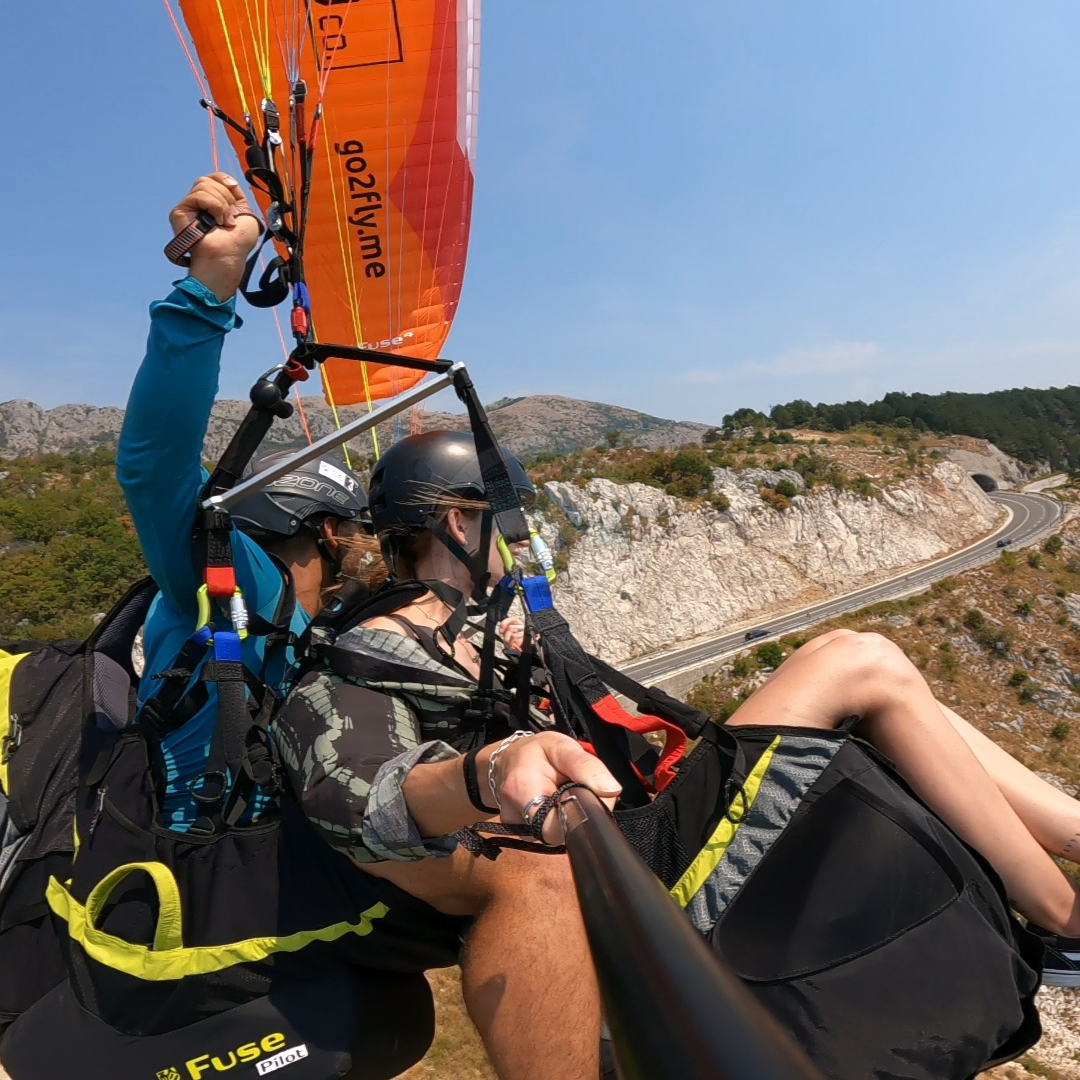
Many people, when they see someone in the air with a parachute or a wing, assume that these are the same sports. However, paragliding, parasailing, and skydiving are completely different activities. If you’re considering a flight over Budva, it’s important to know what to expect from each of these adventures.
What is paragliding and how does it work?
Paragliding is an aerial sport where the pilot uses a specially designed wing (paraglider) to fly, utilizing lift and thermal currents. Unlike a parachute, which is designed to slow down the descent, a paraglider has an aerodynamic profile similar to an airplane wing, allowing it to glide and soar through the air rather than just falling.
One of the biggest advantages of paragliding is that the pilot can gain altitude by using updrafts, allowing for longer and more controlled flights. In ideal conditions, experienced pilots can fly for several hours and cover distances of hundreds of kilometers, relying solely on the power of natural air currents!
Solo and tandem paraglider – what’s the difference?
There are two main types of paragliders:
- Solo paraglider – used by a single pilot who independently controls the aircraft. To fly solo, you must undergo proper training and obtain a license.
- Tandem paraglider – designed for two people: a passenger and a professional pilot. The tandem wing is larger and more stable, with the pilot controlling the flight while the passenger enjoys the view and the experience. To become a tandem pilot, one must have at least two years of solo certification and 200 hours of flight time before starting training for the tandem license.
At Go2FLY, we offer tandem paragliding flights in Budva, where you can safely enjoy the view of the Adriatic Sea and the Montenegrin coast with a professional pilot, no prior experience required!
How is a paraglider controlled?
A paraglider is a fully controllable aircraft. The pilot uses control inputs to change direction and speed, similar to an airplane, but with the help of their body and lines. Additionally, an experienced pilot can use thermal currents to gain altitude and extend the flight duration.
Differences between paragliding, parasailing, and skydiving.
Why choose paragliding in Budva?
- Aerodynamic flight – a paraglider not only slows down the descent but also allows for true flight, thanks to its wing profile similar to that of an airplane.
- Longest flight duration – while skydiving lasts only a few minutes, paragliding can last for several hours, depending on the weather conditions.
- Ability to gain altitude – with the help of updrafts, the pilot can climb to higher altitudes and cover distances of several hundred kilometers.
- Complete control – the pilot can choose the route, adjust the altitude, and use air currents to extend the flight.
- No sudden adrenaline shock – unlike skydiving, where you experience freefall, paragliding provides a feeling of smooth gliding through the air.
- Soft landing – unlike skydiving, where you often land at high speed, paragliding allows for a gentle and controlled landing on grassy or sandy surfaces.
How to book a tandem paragliding flight?
If you want to experience a real motorless flight, not just a brief lift like in parasailing, book your tandem paragliding flight with us through our website www.go2fly.me. Come and feel the freedom of flying above Budva!